

To mitigate against the risk of class actions, many companies include mandatory arbitration agreements and class action waivers in their online terms of service. There has been a flurry of recent litigation about whether users are actually bound to these arbitration agreements and class action waivers. Courts have made clear that a link to a terms of service in a website footer is insufficient to bind users. Instead, users must receive clear and conspicuous notice, and they must manifest assent. But what does this mean in practice? What might seem like a simple implementation detail has become a study in UI design, with plenty of trapdoors.
A recent California decision is a good reminder that certain ingredients are essential—namely, explicit language telling users that by checking a box or clicking a specific action button (e.g., “Pay Now” or “Submit”), they are agreeing to the site’s terms of service.
The Case
In Sanchez v. Maggi London, 2025 WL 3097931 (S.D. Cal. Nov. 6, 2025), the plaintiff purchased clothing advertised as on sale from the defendant retailer’s online store. She alleged that the “strike through” reference price was not the prevailing market price in the 90 days before her purchase, in violation of California false advertising and unfair competition laws.
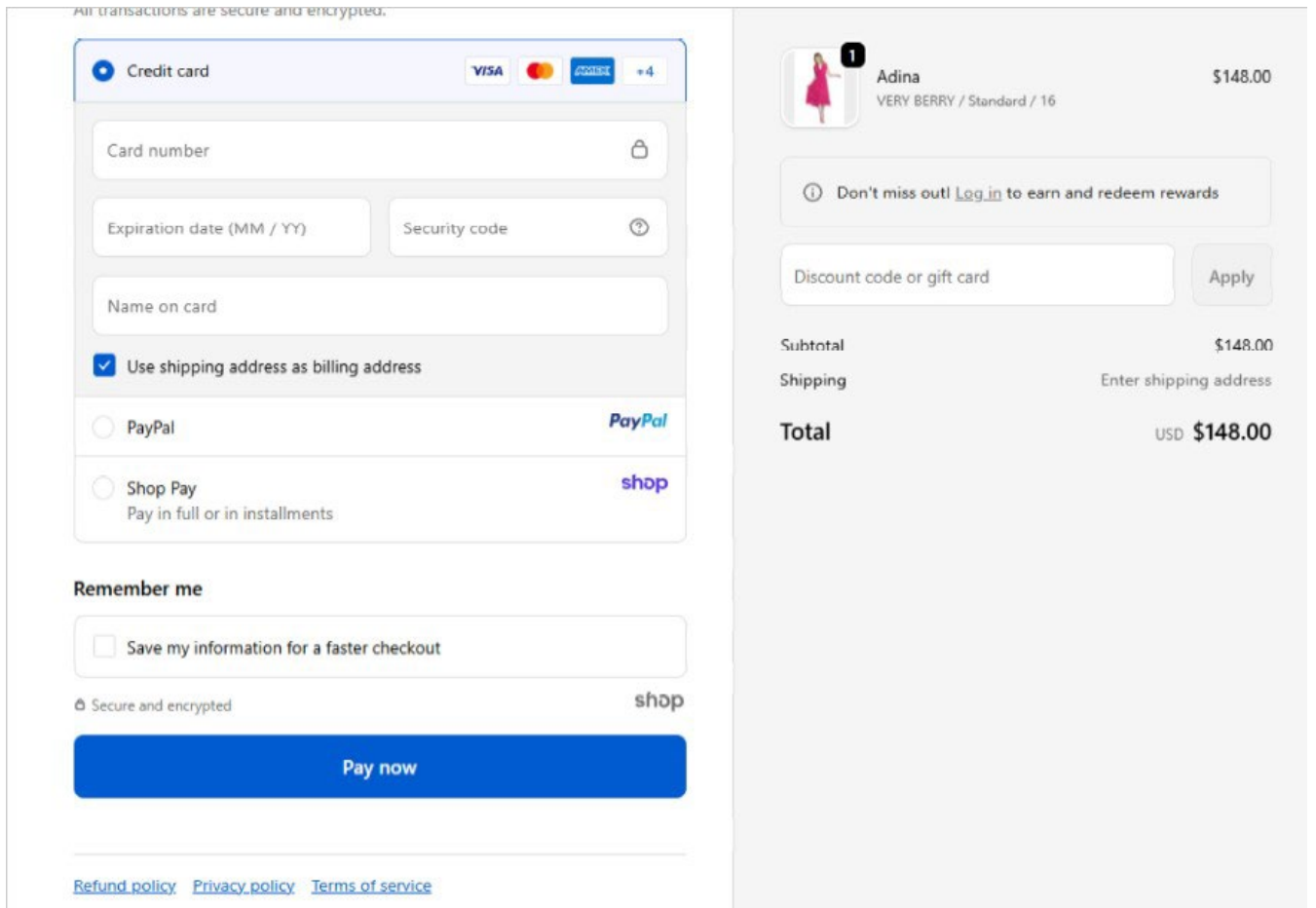
The retailer moved to compel arbitration on the ground that the plaintiff agreed to its online terms of service—containing an arbitration agreement—on the checkout page:
The Decision
To bind a user to an online terms of service, California courts generally require (1) conspicuous notice of the terms, and (2) unambiguous manifestation of assent to those terms.
The court here agreed that the retailer provided consumers with conspicuous notice of the link to the terms of service. The “terms of service” hyperlink appeared in blue, underlined text near the “Pay Now” button that a user must click to complete the online purchase.
But the court held that the plaintiff had not manifested unambiguous consent. The checkout page lacked call-to-action language—i.e., there was no statement that clicking “Pay Now” would mean agreement to the terms of service. For that reason, the court denied the motion.
As the court emphasized, “[a] link to the terms of service, absent more, is not enough.” To provide adequate inquiry notice, the checkout page must contain explicit language that the user’s purchase will legally bind them to the terms.
Notably, the plaintiff here is a serial litigant who has filed numerous class actions against e-commerce sites. So, the defendant retailer also argued that, given her experience, she must have understood that the terms of service were meant to apply to her purchase, even if a general reasonable user might not. The court rejected this argument. Her status as a “tester” did not establish that she had actual notice that she was agreeing to the retailer’s terms of service.
Takeaways
This decision underscores that a terms-of-service link alone is not enough. At a minimum, checkout and sign-up flows should:
Place the terms of service link immediately adjacent to the action button (ideally above); and
Include clear call-to-action language, such as: “By clicking ‘Pay Now,’ you agree to our Terms of Service [link] and acknowledge our Privacy Policy [link].”
As courts continue to scrutinize online contract formation, now is a good time for product, UX, and legal teams to review and update their flows to ensure they include both notice and assent language.

/Passle/5cb04e9a989b6e13ecfcf95d/SearchServiceImages/2026-08-13-04-04-12-271-6a7d423c312bb128ee75f9f3.jpg)
/Passle/5cb04e9a989b6e13ecfcf95d/SearchServiceImages/2026-07-29-14-59-38-687-6a6a155a7b233ab23d628568.jpg)
/Passle/5cb04e9a989b6e13ecfcf95d/SearchServiceImages/2026-06-23-15-33-03-756-6a3aa72f117422070cd62a94.jpg)
/Passle/5cb04e9a989b6e13ecfcf95d/SearchServiceImages/2026-05-29-17-48-37-335-6a19d17534616b2ba0fc1773.jpg)


