
In an interesting albeit very preliminary ruling, a federal court in Illinois has ruled that the Chicago Cubs have successfully stated a claim against a neighboring business which offers rooftop views of the live baseball games being played at Wrigley Field. In its decision in Chicago Cubs Baseball Club. LLC. v. Dunican et al. available here, the court ruled that the Cubs may proceed with claims for misappropriation and unjust enrichment.
Here are the facts in a nutshell. The plaintiff owns and operates the Chicago Cubs as well as Wrigley Field (where the Cubs play their home games). The Defendants own and operate a business called Wrigley Field Rooftop which permits up to 200 guests to enjoy a “bird's-eye view of the ballpark,” “breathtaking views of historic Wrigley Field and the iconic scoreboard” and bleachers that overlook the field and a clubhouse with multiple plasma TVs." At an earlier point, defendants had a license from the Cubs to sell tickets to access their rooftop bleachers, but that license ended.
The Cubs brought suit alleging that Defendants had misappropriated its property right to the Cubs games by selling the rooftop tickets. They claimed that Defendants were being unjustly enriched by such sales and by the collateral sales of food, drink and other concessions. Defendants moved for judgment on the pleadings (a procedural device that is functionally equivalent to a motion to dismiss other than with respect to timing). Defendants argued that Plaintiff does not have the exclusive right to provide the experience of a live baseball game and that it has its own right to enjoy the benefit of its property and the views therefrom.
The court ruled in favor the Cubs, allowing the case to go forward. It rejected Defendants' assertion that the Cubs do not have a property interest in the live Cubs games it “produces” at Wrigley Field. In so holding, it cited a 1938 case in which the Pittsburgh Pirates were found to have a property interest in the games played in its ballpark and that defendant radio station violated its rights by positioning observers outside the stadium where they could observe the games and broadcast live updates. Pittsburgh Athletic Co. v. KQV Brand Co., 24 F. Supp. 490 (W.D. Pa. 1938). The court noted that the concept that sports teams have a property right in profits from their live games has been accepted by other courts.
The court further accepted that the Cubs had successfully alleged damages in the form of lost revenue. It is possible that some fans will purchase tickets to Defendants' rooftop instead of to Wrigley Field, thus depriving the Cubs of revenue from ticket sales, concessions and merchandise. The court concluded that “Plaintiff's allegations that Defendant [sic] uses Plaintiff's own product to compete against it, all while receiving a ”free ride," are sufficient to demonstrate commercial damage caused by that use.
The Cubs claim for unjust enrichment was also sustained. Plaintiffs had properly alleged that Defendants have received a benefit to Plaintiff's detriment and that Defendants' retention of the benefit “violates the fundamental principles of justice, equity and good conscience.”
In short, Defendants motion for judgment on the pleadings was denied and the case will proceed.
A couple of things to note. The Cubs included claims under the federal Lanham Act for trademark infringement, unfair competition and false advertising as well as a claim for deceptive trade practices under Illinois law. These claims were mostly based upon Defendants’ use of trademarks belonging to the Cubs in connection with its marketing and sale of goods. Defendants denied these claims but did not move for judgment on the pleadings for dismissal. In order to prove these claims, the Cubs may face a challenge to prove consumer confusion or deception. But that remains to be seen.
Also, the case does not involve any appropriation of the broadcasts of the Cubs games, so it does not appear to raise any copyright infringement or preemption issues
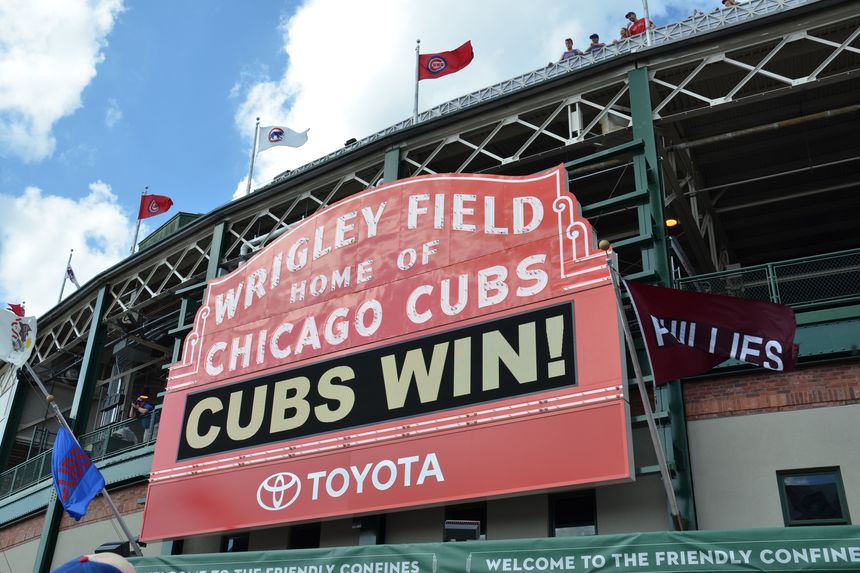
It took the Cubs 108 years (from 1908 to 2016) to win the World Series. Perhaps with this win, the team is on a streak?
/Passle/5cb04e9a989b6e13ecfcf95d/SearchServiceImages/2026-08-13-04-04-12-271-6a7d423c312bb128ee75f9f3.jpg)
/Passle/5cb04e9a989b6e13ecfcf95d/SearchServiceImages/2026-07-29-14-59-38-687-6a6a155a7b233ab23d628568.jpg)
/Passle/5cb04e9a989b6e13ecfcf95d/SearchServiceImages/2026-06-23-15-33-03-756-6a3aa72f117422070cd62a94.jpg)
/Passle/5cb04e9a989b6e13ecfcf95d/SearchServiceImages/2026-05-29-17-48-37-335-6a19d17534616b2ba0fc1773.jpg)


