
In 2022, Ankit Sahni submitted a copyright registration application to the United States Copyright Office. He had taken a photograph of a sunset over a building, fed it into AI image-editing software, and instructed the program to render the image in the style of Vincent van Gogh's Starry Night. The result was Van Gogh in feel but grounded in Sahni's original photograph.
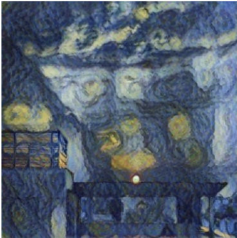
The Copyright Office refused to register it multiple times, concluding that the work was "not the product of human authorship" because the expressive visual elements had been generated by the AI tool rather than by Sahni himself.
Earlier this month, Sahni filed suit in the Central District of California. See Suryast U.S. Enterprises, LLC v. Perlmutter, No. 2:26-cv-4999 (C.D. Cal., filed May 8, 2026). The lawsuit arrives at a moment when the copyright framework for AI-generated works is taking shape — but key questions still unanswered.
What the Courts Have (Mostly) Settled
The threshold question — can a machine be an author? — is now largely resolved. In March 2025, the U.S. Court of Appeals for the D.C. Circuit affirmed the Copyright Office's denial of registration for an image generated entirely and autonomously by Dr. Stephen Thaler's "Creativity Machine," an AI system that Thaler listed as the work's sole author with no human creative contribution claimed. Thaler v. Perlmutter, 130 F.4th 1039 (D.C. Cir. 2025). The court held that the Copyright Act, read as a whole, requires human authorship as a matter of statutory text — machines cannot be authors. The court explicitly noted that it was not deciding how much human creative direction is sufficient when a human uses AI as a tool. That question was not before it because Thaler never claimed any human involvement at all. On March 2, 2026, the U.S. Supreme Court declined to hear the case, leaving Thaler intact.
What Remains Open
In January 2025, the Copyright Office published a report on the copyrightability of AI-generated works, after a formal notice-and-comment process that drew more than 10,000 public comments. The report concluded that existing copyright law is adequate to resolve these questions without legislative change, and set out its analytical framework: AI used as an assisting tool does not defeat copyright; purely AI-generated material is not protected; and cases in between must be assessed on their individual facts.
On the specific question of prompts, the report concluded that prompts alone are insufficient — they "essentially function as instructions that convey unprotectable ideas" — pointing to the unpredictability of AI outputs as evidence that prompt writers lack the degree of control copyright requires. But the report also recognized that human authors are entitled to copyright in expression that is perceptible in AI outputs, including through "creative selection, coordination, or arrangement of material in the outputs, or creative modifications of the outputs."
The tension in that framework (as the cases described below illustrate) is apparent. The Office says copyrightability must be assessed case-by-case and acknowledges that human creative selections perceptible in the output are protectable, yet in practice applies what its critics describe as a categorical rule: any AI involvement in the expressive elements defeats registration, regardless of the specific human choices that shaped the work.
A Parallel Challenge - Allen v. Perlmutter
Sanhi's case is not the first case to test that tension. Allen v. Perlmutter, No. 1:24-cv-02665 (D. Colo., filed Sept. 26, 2024), involves an AI-assisted image generated through more than 600 iterative prompts to an AI tool called Midjourney and further refined in Photoshop. Like Sanhi, Allen brought his challenge under the Administrative Procedure Act — the same legal framework that allows courts to set aside agency action that is arbitrary, capricious, or contrary to law. Allen argued the Copyright Office applies a double standard: photographers receive copyright even when their cameras produce unexpected results or chance plays a role in the outcome, yet AI users are held to a standard of precise expressive control the Office has never applied elsewhere. The government responded that Allen's prompts amounted to ideas communicated to a system that then made its own expressive choices and that, regardless, Allen could have obtained registration for his Photoshop contributions had he simply agreed to disclaim the AI-generated portions of his work, which he declined to do. Cross-motions for summary judgment were fully briefed earlier this year, and a forthcoming ruling will likely be the first court decision to squarely address how much human creative direction suffices for copyright protection of AI-assisted works.
Sanhi's Challenge
The Suryast complaint frames its challenge not as a direct copyright question but as an administrative law one. Under the APA, the question is not whether the Copyright Office reached the right answer, but whether it acted arbitrarily and capriciously in reaching it — specifically, by applying a blanket rule without engaging with the specific facts of Sahni's case.
Those facts may present a stronger argument than Allen's. Sahni's starting point was his own original photograph — i.e., his work, clearly human-authored. He then selected a specific named artistic style and directed the AI tool to transform his photograph accordingly. Unlike a text-to-image tool, which generates an entirely new image from a written description, the AI tool here allegedly edited directly on Sahni's own creative work and applied a transformation he specified. So, unlike in Allen, the question of what, exactly, the Copyright Office would ask Sahni to disclaim is unclear; the photograph is his, and his choice of style directed the transformation. Plus, the Copyright Office's own report says human authors are entitled to copyright in creative selections perceptible in AI outputs. Here, Sahni's creative selections (the original photograph, the choice of Van Gogh style) are directly perceptible in the final image. Thus, if the Office's own framework calls for case-by-case analysis, and the human-authored inputs are perceptible in the output, what more is required for copyright protection?
A successful APA challenge in either case would not necessarily establish that AI-assisted works are broadly copyrightable. It might only require the Copyright Office to conduct a more genuinely fact-specific inquiry rather than applying a categorical rule. But that narrower outcome could itself be substantial: if courts require the Office to assess human creative control case by case, artists and developers who use AI as part of a deliberate creative process would have a path to registration that the current policy appears to foreclose.

/Passle/5cb04e9a989b6e13ecfcf95d/SearchServiceImages/2026-08-13-04-04-12-271-6a7d423c312bb128ee75f9f3.jpg)
/Passle/5cb04e9a989b6e13ecfcf95d/SearchServiceImages/2026-07-29-14-59-38-687-6a6a155a7b233ab23d628568.jpg)
/Passle/5cb04e9a989b6e13ecfcf95d/SearchServiceImages/2026-06-23-15-33-03-756-6a3aa72f117422070cd62a94.jpg)
/Passle/5cb04e9a989b6e13ecfcf95d/MediaLibrary/Images/2026-05-28-20-11-03-576-6a18a157b652930e76ae71f3.png)


