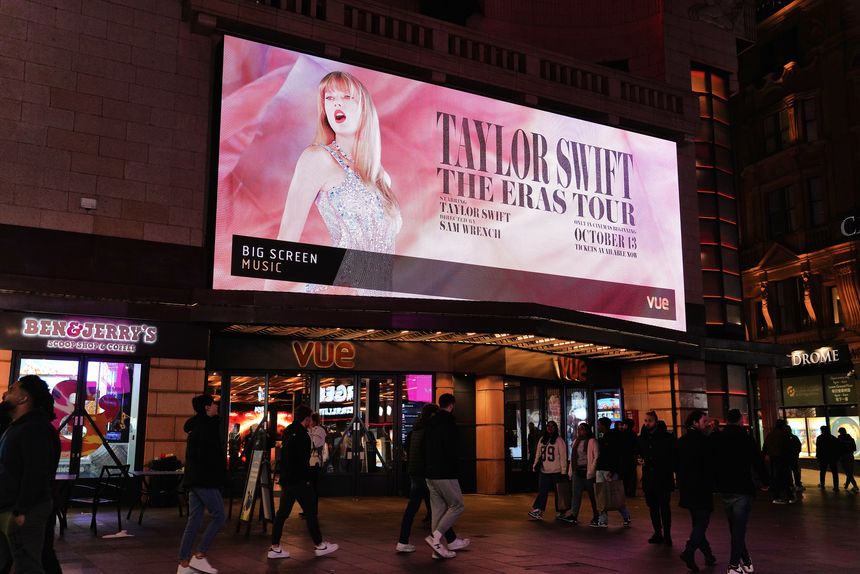

Taylor Swift is no stranger to using trademark law to protect her brand and identity. She has used filings with the United States Patent and Trademark Office and the Trademark Trial and Appeal Board as a method to protect the words, symbols…. and sounds that fans and haters alike indisputably have come to associate with her. Most recently, in February of this year Swift enforced her rights by initiating an opposition proceeding that resulted in the abandonment of a stylized logo for SWIFT HOME. The stylization and font of SWIFT in the logo came too close to Swift’s own signature.
In a proactive bid for protection, TAS Rights Management, LLC, Swift’s company, filed three new applications in connection with various entertainment services. Swift filed applications for two sound marks: HEY, IT’S TAYLOR and HEY, IT'S TAYLOR SWIFT. She also filed an application for a visual mark described as consisting of “a photograph of Taylor Swift holding a pink guitar, with a black strap and wearing a multi-colored iridescent bodysuit with silver boots. She is standing on a pink stage in front of a multi-colored microphone with purple lights in the background.”
Swift is not the first celebrity to register sensory marks of their voices and phrases or sounds they are known for. In late 2025, Matthew McConaughey achieved registration for potentially the most famous word ever uttered three times ALRIGHT ALRIGHT ALRIGHT, which he first delivered in 1993 movie Dazed and Confused. Since then, the phrase has become synonymous with him, making it a perfect example of a sound that identifies its source. Even before that, in 2019 Mr. 305, Pitbull himself, achieved registration for the sound of a “… man yelling "EEEEEEEYOOOOOO" in falsetto with "E" drawn out followed by a "U" sound.”
Unlike McConaughey and Pitbull’s registrations, which feature terms and sounds that can be associated with anyone but were arguably made famous by the men who delivered them, Swift takes a more direct approach, as the marks include her name and appearance.
These filings, especially Swift’s, provide a view as to how celebrities are thinking about protecting their images and likenesses in the age of AI and deepfakes. Trademark rights, which were not traditionally associated with protection of one’s likeness, be it in appearance or sound, are being leveraged today to do exactly what they always were meant to: award protection for marks that identify the source of goods and services. It will be interesting to see if the USPTO agrees that the subject marks of Swift’s applications do just that, or if Swift will walk away with Sweet Nothing.
/Passle/5cb04e9a989b6e13ecfcf95d/SearchServiceImages/2026-08-13-04-04-12-271-6a7d423c312bb128ee75f9f3.jpg)
/Passle/5cb04e9a989b6e13ecfcf95d/SearchServiceImages/2026-07-29-14-59-38-687-6a6a155a7b233ab23d628568.jpg)
/Passle/5cb04e9a989b6e13ecfcf95d/SearchServiceImages/2026-06-23-15-33-03-756-6a3aa72f117422070cd62a94.jpg)
/Passle/5cb04e9a989b6e13ecfcf95d/SearchServiceImages/2026-05-29-17-48-37-335-6a19d17534616b2ba0fc1773.jpg)


